Successful architects accommodate the needs of their clients, but designers of religious facilities are charged with conceiving spaces that nurture faith and inspire the soul. For millennia, many of the world’s most iconic architectural achievements have been driven by religion, including Gothic cathedrals in Europe and ancient temples throughout Asia. As contemporary architects continue to express faith through design, the results can be heavenly.
Julio Bermudez, a leading architectural scholar and author of the book Transcending Architecture: Contemporary Views on Sacred Space, states, “At its best, architecture produces the impossible, which is effortlessly catapulting us into the metaphysical, into God.” Bermudez explains that Christianity, Judaism and Islam all have a tradition of prioritizing size for their houses of worship. “It’s pretty safe to say that the most important element is the scale of a building, especially if you want to achieve a sense of awe or transcendence,” he says. Bermudez, who is a professor of architecture at The Catholic University of America, notes that height — demonstrated by towering spires and minarets around the world — is an important component of scale.
Photos by Hundven-Clements Photography
Modern mastery
Frank Lloyd Wright demonstrated that modern design could convey the same spiritual consciousness as medieval cathedrals. Unity Temple, a church in suburban Chicago, and Beth Shalom Synagogue outside Philadelphia are examples of the master’s ability to imagine sacred spaces through a modern lens. The striking Chapel of the Holy Cross —built into dramatic red rock formations in Sedona, Arizona — is another example of divinity expressed through contemporary design. It was designed by architects Richard Hein and August K. Strotz and completed in 1956.
Serving a Unitarian Universalist congregation is Unity Temple in Oak Park, Illinois, Wright’s most famous church project. The building was dedicated in 1909 and is now a UNESCO World Heritage Site. Developmental lead minister Roger Bertschausen reports the church’s architecture inspires worshipers and that many discovered the church community through the building. Wright was raised in a Unitarian household, and the seating design enhances the denomination’s emphasis on human connection and unity. “Everybody has a clear view of the pulpit, but they also see each other, creating a sense of intimacy,” says Bertschausen, who states that Unity Temple is the only UNESCO-designated church in the U.S. still used for its original purpose.
Sacred spaces on a global scale
When an avalanche destroyed the 17th century Church of San Giovanni Battista in the Swiss Alps, renowned Swiss architect Mario Botta was commissioned to replace it with an intimate but audacious design. The elliptical house of worship, clad in alternating dark gray and white stone, crushes perceptions of traditional Catholic sensibilities but maintains a timeless sense of place.
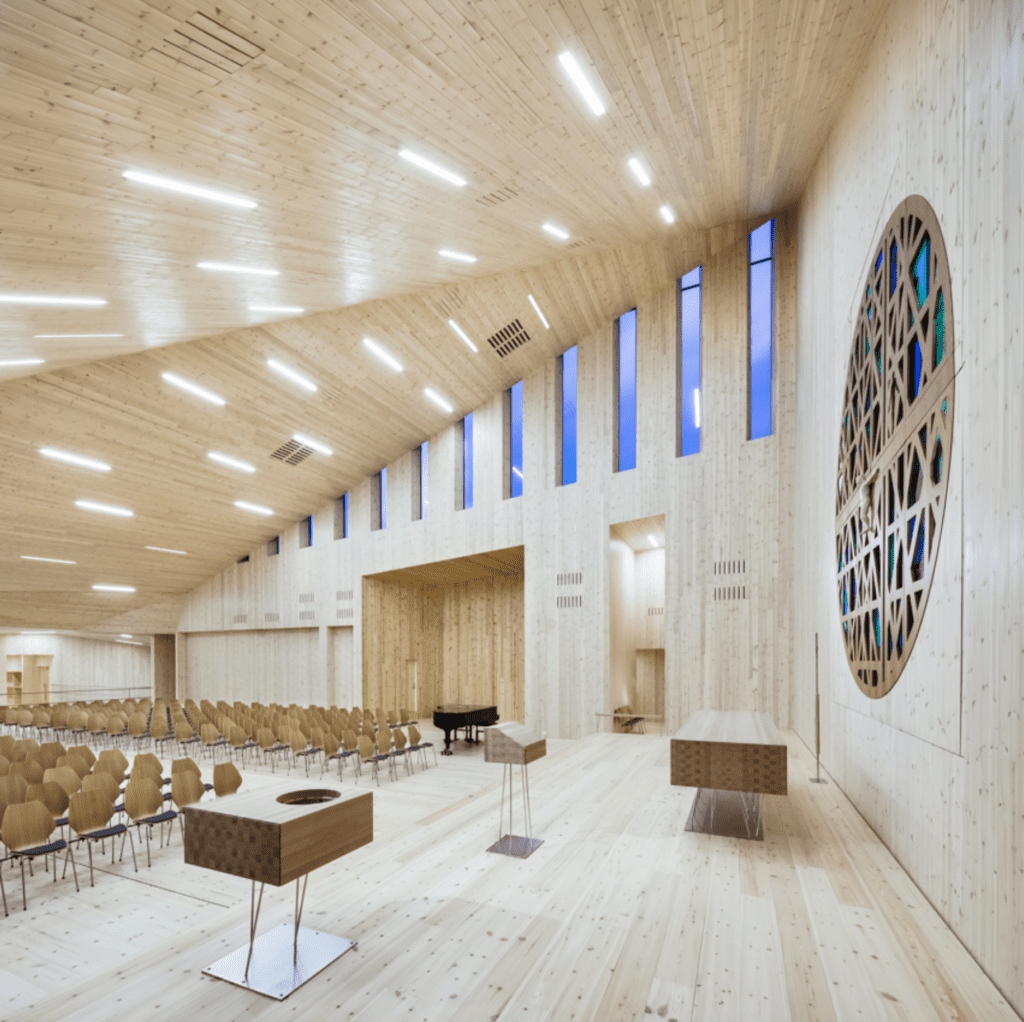
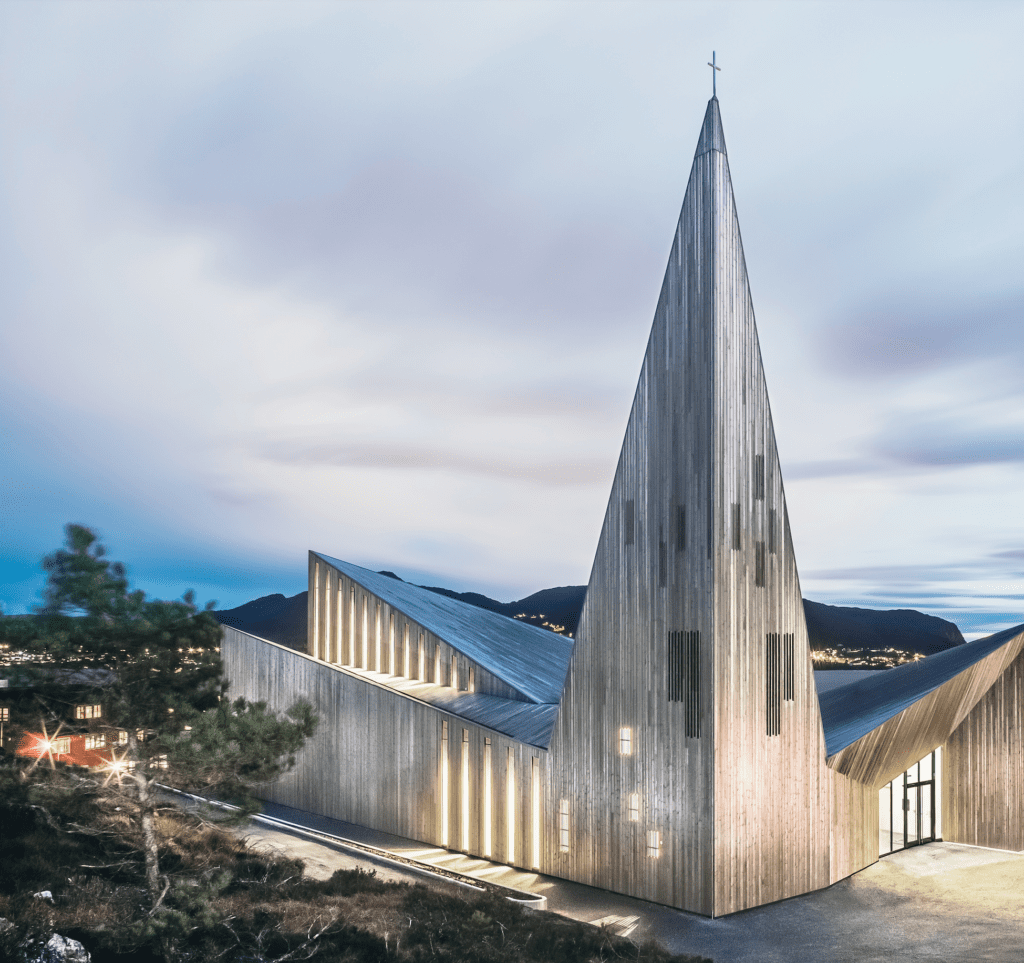
For the sprawling Church of the Holy Family campus in Brazil, Brasilia-based architectural firm ARQBR created four distinct structures, including a sleek circular sanctuary and monolithic bell tower. The raw concrete forms provide a nuanced relationship with the surrounding Brazilian Highlands. In contrast, the severe angles of Norway’s Knarvik Church were wrapped entirely in weathered pine by Reiulf Ramstad Architects, representing another dramatic architectural expression of spirituality.
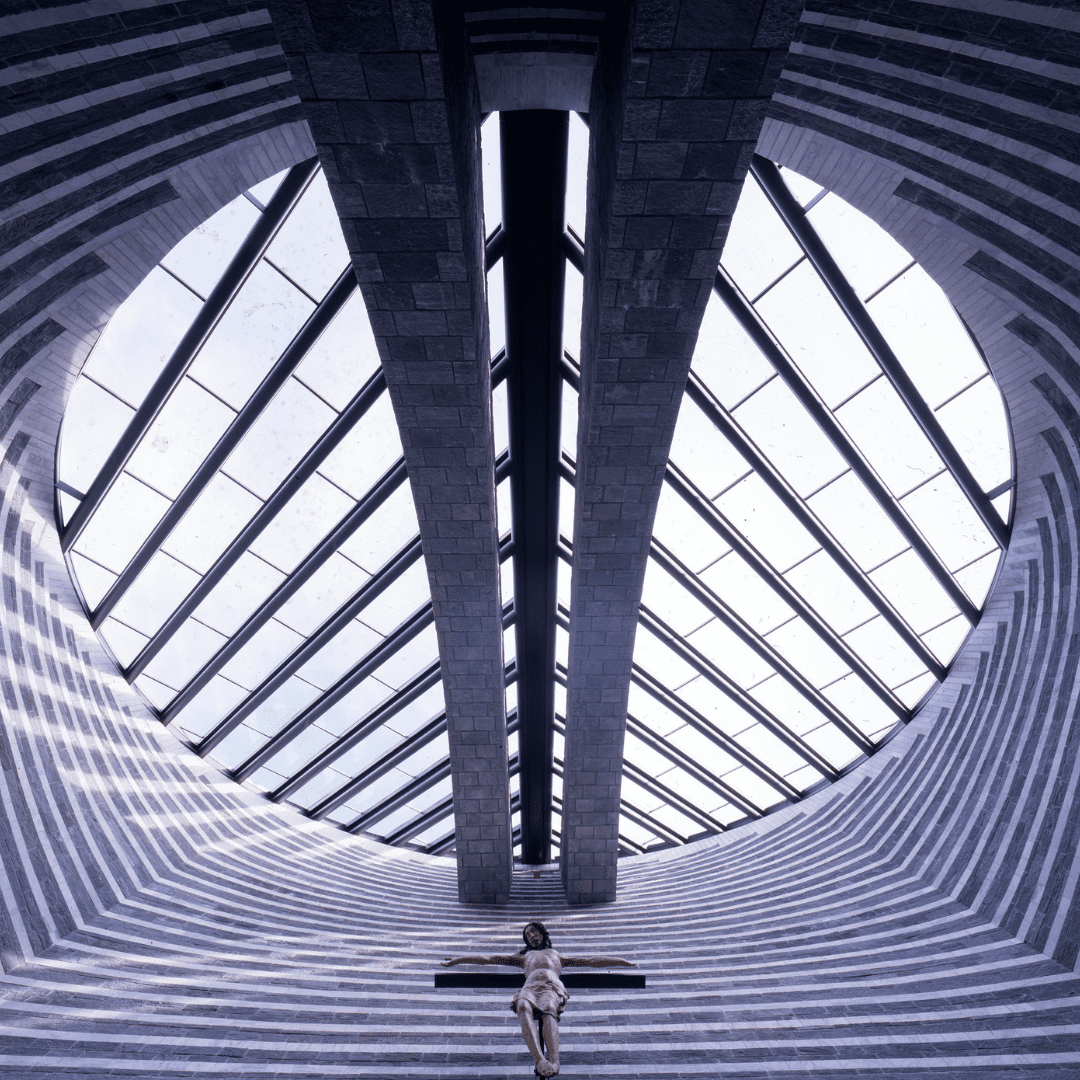
Photo by Enrico Cano
Designing Jewish places of prayer
Specializing in the design of Jewish synagogues is Princeton, New Jersey-based Landau│Zinder Architecture, whose projects often reflect contemporary sensibilities. Managing Partner Joshua Zinder says his firm designs both traditional and modern synagogues, and that orthodox congregations are just as likely to favor contemporary aesthetics as more progressive ones. “The designs reflect the communities and congregations we work with, but in all cases, clients are looking for transcendent spaces where they can connect to God,” says Zinder. He further explains, “More clients are seeking a sense of intimacy, and we can create that without losing a feeling of grandeur or awe.”
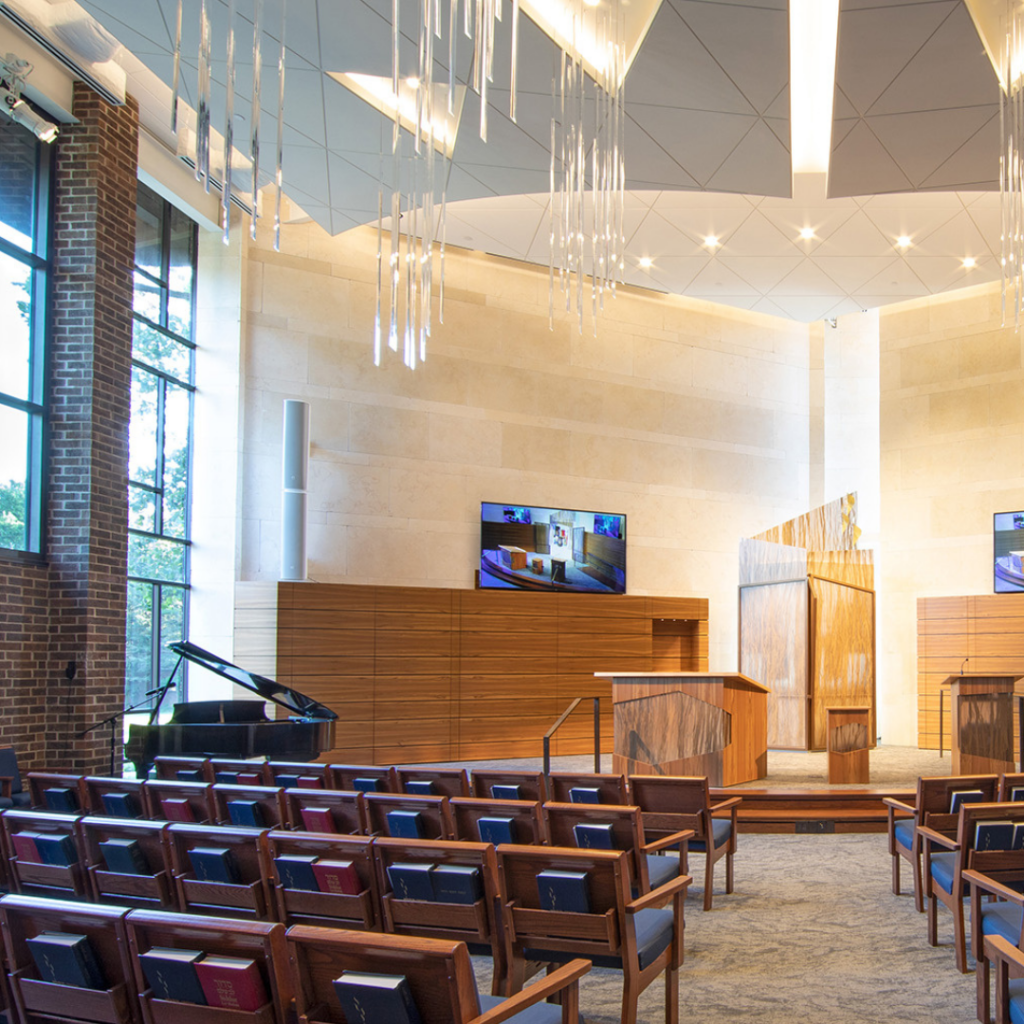
Landau│Zinder brought a modern aesthetic to suburban New York’s Scarsdale Synagogue, which Rabbi Jeffrey Brown reports was universally well received. He explains, “It was time to come into the 21st century, consistent with our values and the kind of Judaism we’re practicing.” Noting that people form an emotional attachment with the building in which they worship, Brown appreciated the architects’ ability to repurpose materials or architectural details valued by longtime members. “People want to take pride in their spiritual home, just as they do their own houses,” explains the rabbi.
The portfolio of Salt Lake City-headquartered FFKR Architects includes hotels and sports arenas, but the firm maintains a studio dedicated to faith-based projects. The Church of Jesus Christ of Latter-day Saints (LDS) has commissioned FFKR for projects around the world, including monumental temples in Utah, Idaho and Arizona. Principal Steve Goodwin explains that while LDS sabbath services are held in relatively humble “meetinghouses,” in the spirit of New England churches, the more grandiose temples are reserved for special ceremonies. “The Church looks for sites that have a presence, sometimes a higher elevation, which contributes to their prominence and transcendence,” says the architect, noting that towering temples have become landmarks in many cities, including Los Angeles and San Diego. Inside, secular spaces transition to more holy spaces, with the “Celestial Room” representing heaven. Conceding a prevalence of classical aesthetics, Goodwin acknowledges that “modernism isn’t frowned upon, but traditional styles are more consistent with the Church’s current approach.”
Photo by Landua│Zinder Architecture
Shattering architectural clichés in Islamic mosques, however, designers are creating ultramodern spaces that forfeit ornate minarets and domes for sleek, streamlined environments. New York-based Diller Scofidio + Renfro, designers of High Line in New York and The Broad in Los Angeles, created Al-Mujadilah Center in Doha, Qatar. It was the renowned firm’s first house of worship and the Muslim world’s first contemporary women’s mosque. Capping the multifaceted project is a gently undulating roof perforated by 5,000 wells that diffuse natural light through the main hall. Principal Elizabeth Diller explains, “The design was partially inspired by Islamic art and architecture, in which abstraction serves to represent the transcendent nature of the divine.”
The Bahá’í Faith operates religious centers around the globe and its House of Worship in New Delhi, India is a modern interpretation of a lotus flower, with 27 massive white marble “petals” reaching for the sky. Designed by Iranian-American architect Fariborz Sahba, this modern landmark is yet another reminder that spiritual inspiration comes in many forms.